By loading this video, YouTube's privacy policy may apply.
動画を読み込むと、YouTubeのプライバシーポリシーが適用されます。
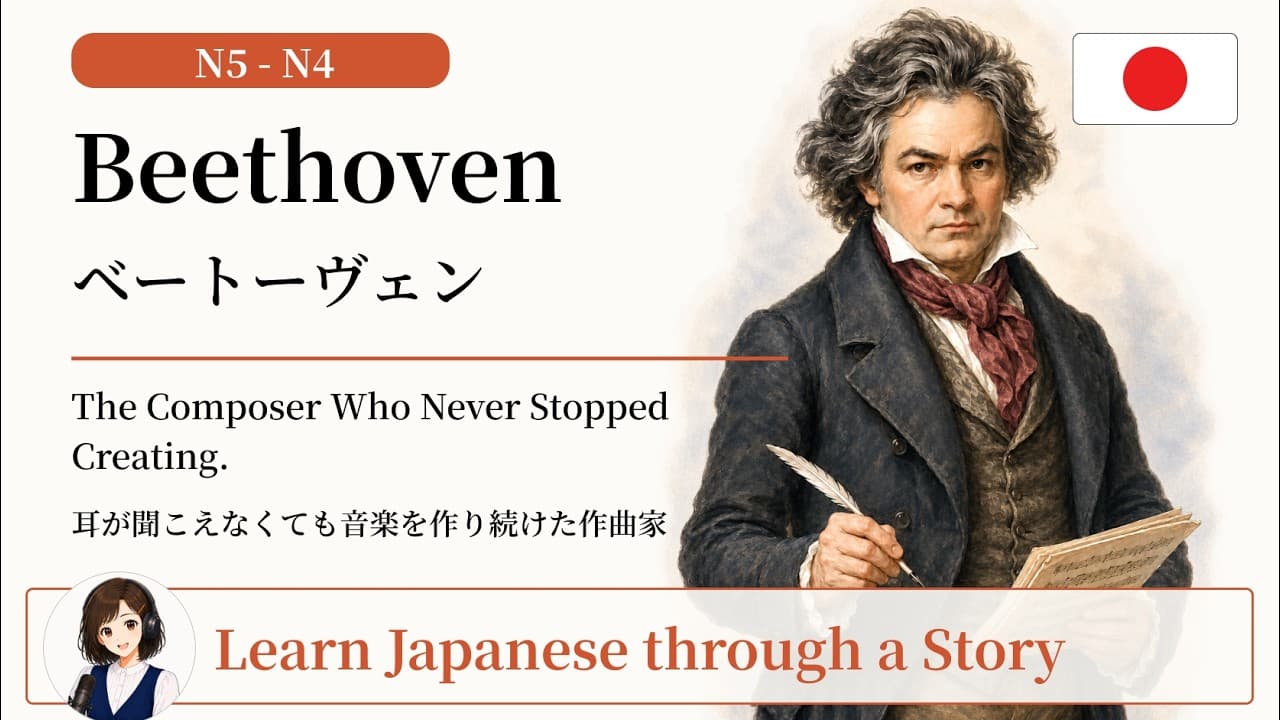
Beethoven: The Composer Who Never Stopped Creating|Learn Japanese N5–N4
Beethoven ― 音が聞こえなくても音楽を作り続けた人
Script
Introduction
Beethoven ― 音が聞こえなくても音楽を作り続けた人
この動画では、ベートーヴェンについて話をします。
In this video, we will talk about Beethoven.
ベートーヴェンは、世界でとても有名なです。
Beethoven is one of the world's most famous musicians.
今から250年以上前に、ドイツのボンという町で生まれました。
He was born more than 250 years ago in the German city of Bonn.
ピアノの曲や、のための曲をたくさん作りました。
He composed many piano pieces and works for orchestra.
彼の音楽は、今でもで演奏されています。
His music is still performed all over the world today.
しかし、ベートーヴェンの人生は、決して簡単ではありませんでした。
However, Beethoven's life was far from easy.
若いころから音楽のがあり、ピアニストとしても有名になりました。
He showed musical talent from a young age and also became famous as a pianist.
でも、30歳になる前から、少しずつ耳が聞こえにくくなっていきます。
But before he turned thirty, he gradually began to lose his hearing.
音楽家にとって、音が聞こえないことは、とても大きな問題です。
For a musician, being unable to hear is an enormous problem.
彼も何度も苦しみました。
He suffered deeply many times.
それでも、音楽を作ることをやめませんでした。
Even so, he never stopped making music.
そして、耳がほとんど聞こえなくなってからも、世界で有名な曲を作りました。
And even after he had lost most of his hearing, he composed works that became famous around the world.
今回は、そんなベートーヴェンが、どのように音楽と生きたのか、その人生を見ていきましょう。
Let us look at how Beethoven lived with music and explore his life.
Chapter 1
音楽が近くにあった子ども時代
1770年、ベートーヴェンはドイツのボンで生まれました。
Beethoven was born in Bonn, Germany, in 1770.
家族には、音楽の仕事をしている人がいました。
Some members of his family worked in music.
父も歌の仕事をしていました。
His father worked as a singer as well.
そのため、ベートーヴェンも小さいころから音楽を学びました。
Because of this, Beethoven began studying music when he was very young.
父は、息子にすばらしい音楽家になってほしいと考えていました。
His father wanted his son to become an outstanding musician.
そして、まだ子どものころから、ピアノなどのをさせました。
So he made Beethoven practice the piano and other instruments while he was still a child.
1778年、ベートーヴェンは子どもながら、人の前でピアノをしました。
In 1778, Beethoven performed the piano in public even though he was still a child.
まだ7歳でした。
He was only seven years old.
少しずつ、まわりの人も彼の才能に気づくようになります。
Little by little, the people around him began to notice his talent.
しかし、ベートーヴェンはピアノを弾くだけではありませんでした。
But Beethoven did more than simply play the piano.
音楽を作ることにもを持っていました。
He was also interested in composing music.
12歳ごろには、自分の音楽が初めてされました。
At around the age of twelve, his own music was published for the first time.
また、などでオルガンを弾く仕事もするようになります。
He also began working as an organist at churches and other places.
14歳ごろには、にオルガンを弾く仕事をしていました。
By around the age of fourteen, he held an official job playing the organ.
まだ若い少年でしたが、すでに音楽を仕事にしていたのです。
Although he was still a young boy, music had already become his profession.
そして、いろいろな音楽家から学びながら、少しずつ自分の力を伸ばしていきました。
He continued to develop his abilities little by little while learning from various musicians.
ベートーヴェンが住んでいたボンは、彼にとって音楽を学ぶ大切な場所でした。
Bonn, where Beethoven lived, was an important place for his musical education.
ここでピアノを弾き、オルガンを弾き、音楽を作りました。
There he played the piano, played the organ, and composed music.
しかし、もっと大きな音楽の世界で学びたいという気持ちも強くなっていきます。
However, his desire to study in a larger musical world grew stronger.
そして、その気持ちは、やがて彼を別の町へ向かわせることになります。
That desire would eventually lead him to another city.
Chapter 2
ウィーンで音楽家になる
1792年、21歳のベートーヴェンはボンを出ました。
In 1792, twenty-one-year-old Beethoven left Bonn.
向かった場所は、オーストリアのウィーンです。
His destination was Vienna, Austria.
当時のウィーンは、音楽がとても盛んな町でした。
At that time, Vienna was a city with a thriving musical culture.
多くの有名な音楽家が住み、たくさんの音楽が演奏されていました。
Many famous musicians lived there, and a great deal of music was performed.
ベートーヴェンは、そこで音楽をもっと勉強したいと考えました。
Beethoven wanted to study music more deeply there.
そして、有名なハイドンからも音楽を学びます。
He also studied under the famous composer Haydn.
最初は、勉強のためにウィーンへ行ったつもりでした。
At first, he intended to go to Vienna only to study.
しかし、その後、ボンへ戻って生活することはありませんでした。
However, he never returned to Bonn to live.
ウィーンが、新しい生活の場所になったのです。
Vienna became his new home.
ベートーヴェンは、ピアノがとても上手でした。
Beethoven was an exceptionally skilled pianist.
特に、その場で音楽を考えながら弾くことが得意でした。
He was especially good at improvising music as he played.
演奏を聞いた人たちは、その強い音や新しいに驚きました。
People who heard him were amazed by his powerful sound and fresh expression.
少しずつ、ウィーンでも名前が知られるようになります。
Little by little, his name became known in Vienna as well.
1795年には、ウィーンで大きな舞台に立ち、ピアノを演奏しました。
In 1795, he appeared on a major stage in Vienna and performed on the piano.
また、自分で作った音楽もするようになります。
He also began presenting music that he had composed himself.
ピアニストとして演奏しながら、作曲家としてもしていきました。
While performing as a pianist, he also developed as a composer.
当時、音楽家が生活するためには、お金を出して助けてくれる人も大切でした。
At the time, musicians needed patrons who would provide financial support.
ベートーヴェンにも、彼の音楽を好きになり、仕事を助けてくれる人たちがいました。
Beethoven also had people who admired his music and supported his work.
少しずつ、自分の音楽だけで生きていく道を作っていきます。
Little by little, he created a way to make a living through his own music.
若いベートーヴェンにとって、このころはの多い時代でした。
For the young Beethoven, this was a time filled with hope.
音楽家として有名になり、新しい曲を次々と作っていました。
He was becoming famous as a musician and composing one new work after another.
しかし、その生活の中で、大きな問題が始まります。
But during this period, a serious problem began.
Chapter 3
少しずつ聞こえなくなる音
20代の終わりごろ、ベートーヴェンは自分の耳に問題があることに気づきました。
In his late twenties, Beethoven noticed that something was wrong with his ears.
前は聞こえていた音が、よく聞こえません。
Sounds he had once heard clearly became difficult to hear.
人が小さな声で話すと、言葉が分かりにくいこともありました。
When people spoke quietly, he sometimes had trouble understanding their words.
耳の中で、いつも音がすることもありました。
He also sometimes heard a constant noise in his ears.
最初、彼はこのことを多くの人には話しませんでした。
At first, he did not tell many people about it.
なぜなら、ベートーヴェンは音楽家だったからです。
That was because Beethoven was a musician.
ピアノを弾き、人の演奏を聞き、音楽を作ることが仕事です。
His work was to play the piano, listen to performances, and compose music.
その音楽家が、「耳が聞こえにくい」と言うことは、とても怖いことでした。
For a musician to admit that he was losing his hearing was terrifying.
何人ものに相談しました。
He consulted many doctors.
いろいろな方法を試しました。
He tried various treatments.
しかし、耳はよくなりませんでした。
However, his hearing did not improve.
むしろ、少しずつ悪くなっていきました。
Instead, it gradually became worse.
1801年、友人への手紙の中でも、耳の問題について書いています。
In an 1801 letter to a friend, he wrote about his hearing problems.
遠くの音が聞こえない。
He could not hear distant sounds.
人の声も分かりにくい。
He also had difficulty understanding people's voices.
そんな生活に、とても苦しんでいました。
This way of life caused him great suffering.
1802年には、ウィーンの近くのハイリゲンシュタットという場所で、家族に向けた長い文章を書きました。
In 1802, in a place near Vienna called Heiligenstadt, he wrote a long letter addressed to his family.
そこには、耳が聞こえなくなることへの苦しい気持ちが書かれています。
In it, he described the anguish he felt as he lost his hearing.
人と話すことも難しくなりました。
Talking with other people also became difficult.
音楽家なのに、音が聞こえない。
He was a musician, yet he could not hear sound.
自分の仕事を続けられるのだろうか。
Would he be able to continue his work?
彼は、とても深く悩みました。
He struggled with this question very deeply.
それでも、人生を終わらせるのではなく、音楽を作る道を選びます。
Even so, rather than ending his life, he chose the path of continuing to compose music.
まだ自分には作りたい音楽がある。
There was still music he wanted to create.
その思いが、彼を前へ進ませました。
That thought helped him move forward.
Chapter 4
聞こえにくくても作り続ける
耳の問題が大きくなっても、ベートーヴェンは作曲を続けました。
Even as his hearing problems grew more serious, Beethoven continued composing.
むしろ、この時代にたくさんの有名な曲が生まれています。
In fact, many of his most famous works were created during this period.
その一つが、第5番です。
One of them was Symphony No. 5.
最初の短い音は、世界中でよく知られています。
Its short opening motif is known throughout the world.
ベートーヴェンはこの曲を何年もかけて作りました。
Beethoven spent years composing this symphony.
そして1808年、ウィーンで初めて演奏されました。
It was first performed in Vienna in 1808.
このころには、すでに耳の問題がありました。
By then, he was already experiencing serious hearing problems.
それでも、頭の中で音楽を考え、それを紙に書いていきます。
Even so, he imagined music in his mind and wrote it down on paper.
音楽を作るとき、すべての音を実際に聞かなければならないわけではありません。
Creating music does not always require physically hearing every sound.
ベートーヴェンは、子どものころから長い時間、音楽を学んできました。
Beethoven had studied music for many years since childhood.
たくさんの音を知っていました。
He knew a great many sounds.
の音も知っていました。
He also knew the sounds of different instruments.
どの音とどの音を一緒にすると、どんな音楽になるのか。
What kind of music would result from combining one sound with another?
そのようなことが、頭の中にたくさん入っていました。
His mind was filled with knowledge like this.
その力を使いながら、作曲を続けました。
Using that ability, he continued composing.
しかし、人の前でピアノを演奏することは、だんだん難しくなります。
However, performing the piano in public gradually became more difficult.
耳が悪くなると、自分が弾いている音をすることも難しくなるからです。
As his hearing worsened, it became harder to check the sounds he was playing.
1810年代になると、人の前でピアノを弾く仕事から少しずつ離れていきました。
In the 1810s, he gradually withdrew from public piano performances.
やがて、人との普通のも難しくなります。
Eventually, even ordinary conversation became difficult.
1818年ごろからは、話をするときにノートを使うことが増えました。
From around 1818, he increasingly used notebooks when speaking with people.
相手がノートに言葉を書きます。
The other person would write words in a notebook.
ベートーヴェンはそれを読み、話をしました。
Beethoven would read them and respond.
耳から入る音は、どんどん少なくなっていきました。
The sounds entering his ears became fewer and fewer.
でも、頭の中の音楽はなくなりませんでした。
But the music inside his mind never disappeared.
外の世界が静かになっても、彼は新しい音楽を考え続けていたのです。
Even as the outside world grew silent, he continued imagining new music.
Chapter 5
耳が聞こえない中で作った第九
1820年代になると、ベートーヴェンの耳はほとんど聞こえなくなっていました。
By the 1820s, Beethoven had lost almost all of his hearing.
普通に会話をすることも、とても難しいでした。
Even ordinary conversation had become extremely difficult.
しかし、まだ大きな曲を作ろうとしていました。
Yet he was still trying to create a major work.
その一つが、交響曲第9番です。
One of those works was Symphony No. 9.
日本では「第九」と呼ばれることも多い曲です。
In Japan, this piece is often called Daiku, meaning the Ninth.
この曲には、大きながあります。
This symphony has a remarkable feature.
最後の部分で、人の声が入ります。
Human voices enter in its final section.
オーケストラだけではなく、歌う人たちも一緒に音楽を作るのです。
The music is created not only by the orchestra but also by singers.
そこで使われたのが、ドイツのシラーが書いた「喜び」をテーマにした詩でした。
The words came from a poem about joy written by the German poet Schiller.
ベートーヴェンは若いころから、この詩に興味を持っていました。
Beethoven had been interested in this poem since he was young.
そして、長い時間がたったあと、その言葉を大きな交響曲の中に入れました。
Many years later, he placed its words within a grand symphony.
1824年5月7日。
May 7, 1824.
ウィーンで第九が初めて演奏されました。
The Ninth Symphony was performed for the first time in Vienna.
このとき、ベートーヴェンも舞台に立っていました。
Beethoven was also on the stage for the performance.
しかし、実際の演奏は、音楽家たちが別のを見ながら進めていました。
However, the musicians actually followed another conductor as they performed.
ベートーヴェンには、オーケストラの音を十分に聞くことができなかったからです。
This was because Beethoven could not hear the orchestra well enough.
曲が終わると、には大きな拍手が起こりました。
When the piece ended, the hall erupted in loud applause.
でも、ベートーヴェンには、そのが聞こえません。
But Beethoven could not hear that applause.
彼は客席のにもすぐには気づきませんでした。
He did not immediately notice the audience's reaction.
そこで、まわりの人がを見るように伝えました。
So someone nearby prompted him to look toward the audience.
ベートーヴェンが振り返ると、そこには喜んでいる多くの人たちがいました。
When Beethoven turned around, he saw a large crowd of delighted people.
自分には、その音を聞くことができない。
He himself could not hear the sound.
それでも、自分が作った音楽を、多くの人が聞いて喜んでいる。
Even so, many people were listening to the music he had created and rejoicing in it.
ベートーヴェンにとって、とても特別な時間だったことでしょう。
It must have been an extraordinarily special moment for Beethoven.
第九の最後に使われた「喜び」のメロディーは、その後、世界中で知られるようになりました。
The melody of joy used at the end of the Ninth later became famous throughout the world.
耳がほとんど聞こえなくなった音楽家が作った曲が、200年以上たった今も演奏されています。
More than two hundred years later, music composed by a man who had almost completely lost his hearing is still being performed.
Chapter 6
最後まで音楽を作る
第九を作ったあとも、ベートーヴェンは音楽を作り続けました。
Even after completing the Ninth Symphony, Beethoven continued to compose.
耳はほとんど聞こえません。
He could hear almost nothing.
体の調子も少しずつ悪くなっていました。
His physical health was also gradually deteriorating.
それでも、紙に音を書き続けました。
Even so, he continued writing music on paper.
最後の時代には、のための曲なども作っています。
In his final years, he composed works for string instruments and other music.
その音楽は、当時の人にとっても、とても新しく、難しいものでした。
Even people at the time found this music remarkably new and difficult.
ベートーヴェンは、簡単に分かる音楽だけを作ろうとはしませんでした。
Beethoven did not try to create only music that was easy to understand.
自分の中にある音楽を、最後まで形にしようとしました。
He tried to give form to the music inside him until the very end.
1827年3月26日。
March 26, 1827.
ベートーヴェンはウィーンで亡くなりました。
Beethoven died in Vienna.
56歳でした。
He was fifty-six years old.
ボンで音楽を学んでいた少年は、ウィーンへ行き、世界に知られる作曲家になりました。
The boy who had studied music in Bonn went to Vienna and became a composer known around the world.
Summary
この動画のまとめ
今回は、ベートーヴェンの人生を見てきました。
We have looked at Beethoven's life.
1770年、ドイツのボンで生まれました。
He was born in Bonn, Germany, in 1770.
小さいころから音楽を学び、子どもの頃から人前で演奏しました。
He studied music from an early age and performed in public while still a child.
その後、ウィーンへ行き、ピアニスト、そして作曲家として有名になっていきます。
He later went to Vienna and became famous as both a pianist and a composer.
しかし、20代の終わりごろから、耳が少しずつ聞こえにくくなりました。
However, in his late twenties, he gradually began to lose his hearing.
音楽家として、とても大きな問題でした。
For a musician, this was an enormous problem.
何度も悩みました。
He struggled many times.
人と話すことも難しくなりました。
Talking with other people also became difficult.
それでも、音楽を作ることをやめませんでした。
Even so, he never stopped making music.
耳から音が聞こえにくくなっても、頭の中では音楽を考えることができました。
Although sounds became harder to hear, he could still imagine music in his mind.
そして、交響曲第5番や第9番など、今も世界中で演奏される曲を作りました。
He composed works such as Symphonies No. 5 and No. 9, which are still performed around the world today.
特に第九が初めて演奏されたとき、ベートーヴェンはの大きな拍手を聞くことができませんでした。
When the Ninth Symphony was first performed, Beethoven could not hear the audience's thunderous applause.
それでも、彼が作った音楽は多くの人の心に届きました。
Even so, the music he created reached the hearts of many people.
できなくなったことを見るのではなく、まだできることを続ける。
Rather than focusing on what he could no longer do, he continued doing what he still could.
苦しいときでも、自分が大切だと思うことを続ける。
Even in difficult times, he continued pursuing what mattered most to him.
ベートーヴェンの人生からは、そんな強さを見ることができます。
Beethoven's life shows us that kind of strength.