By loading this video, YouTube's privacy policy may apply.
動画を読み込むと、YouTubeのプライバシーポリシーが適用されます。
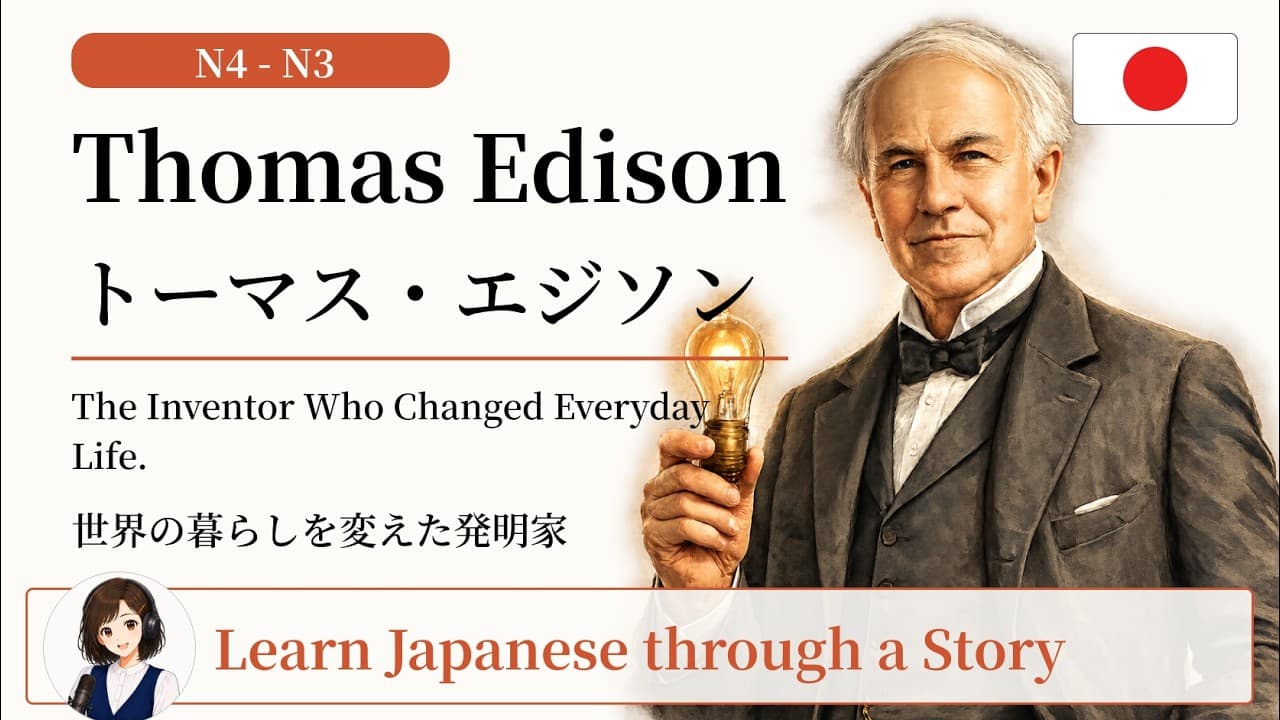
Thomas Edison: The Inventor Who Changed Everyday Life|Learn Japanese N4–N3
トーマス・エジソン ― 世界の暮らしを変えた発明家
Script
Introduction
トーマス・エジソン ― 世界の暮らしを変えた発明家
この動画では、トーマス・エジソンについて話をします。
In this video, we will talk about Thomas Edison.
エジソンは、電球や蓄音機など、私たちの生活を大きく変えた技術に関わった有名なです。
Edison was a famous inventor involved in technologies that greatly changed our lives, including the light bulb and the phonograph.
生涯で、アメリカだけでも1000件以上のを取りました。
During his lifetime, he received more than one thousand patents in the United States alone.
しかし、最初から有名な発明家だったわけではありません。
However, he was not a famous inventor from the beginning.
子どもの頃から色々なことにを持ち、自分で勉強しながら成長しました。
From childhood, he was interested in many things and grew by studying on his own.
若いころにはで新聞を売り、その後は電信の仕事をするようになります。
As a young man, he sold newspapers on trains and later began working as a telegraph operator.
そして、何度も実験とをくり返しながら、新しいものを作り続けました。
He continued creating new things through repeated experiments and failures.
今回は、そんな彼がどのようにして世界的な発明家になったのか、その人生を見ていきましょう。
This time, let us look at his life and how he became a world-famous inventor.
Chapter 1
好奇心の強い少年
1847年、アメリカのオハイオ州で生まれました。
He was born in Ohio, United States, in 1847.
7歳のころ、家族と一緒にミシガン州へ引っ越します。
When he was seven, he moved to Michigan with his family.
学校に通ったは長くありませんでした。
He did not attend school for very long.
その後は、母親から読み書きや計算を教えてもらい、自分でもたくさんの本を読みました。
After that, his mother taught him reading, writing, and arithmetic, and he read many books on his own.
特に好きだったのは、についての本です。
He especially liked books about science.
ただ本を読むだけではなく、自分ですることにも興味を持っていました。
He was interested not only in reading books but also in conducting experiments himself.
13歳になるころには、鉄道の中で新聞やお菓子を売る仕事を始めます。
By the age of thirteen, he had begun selling newspapers and snacks on trains.
まだ少年でしたが、自分で働いてお金を稼いでいました。
He was still a boy, but he worked and earned money by himself.
そして、仕事をしながら電信というにも興味を持つようになります。
While working, he also became interested in the technology of telegraphy.
電信は、電気を使って遠くの人へ情報を送るです。
The telegraph is a system that uses electricity to send information to people far away.
電話やインターネットがなかった時代には、とても重要な技術でした。
In an era without telephones or the internet, it was a very important technology.
16歳になるころには、を使う仕事ができるほど技術を身につけていました。
By the age of sixteen, he had developed enough skill to work as a telegraph operator.
この経験が、後の発明につながっていきます。
This experience would later lead to his inventions.
Chapter 2
発明家への道
若いエジソンは、電信の仕事をしながら、さまざまな町で働きました。
As a young man, Edison worked in various towns while working as a telegraph operator.
しかし、ただ機械を使うだけではありませんでした。
However, he did more than simply operate machines.
どうすればもっと便利になるのか。
How could they be made more convenient?
どうすればもっと速くを送れるのか。
How could information be sent more quickly?
そんなことを考えながら、機械をしていきました。
With these questions in mind, he improved the machines.
その後、ニューヨークで株の値段を伝える機械を改良します。
Later, in New York, he improved a machine that reported stock prices.
この発明が成功し、大きなお金を得ることができました。
This invention succeeded and earned him a large amount of money.
そのお金を使って、自分のを作ります。
He used that money to establish his own laboratory.
そして1876年、ニュージャージー州のメンロパークに、新しい研究所を作りました。
Then, in 1876, he built a new laboratory in Menlo Park, New Jersey.
ここには、さまざまな技術を持つ人たちが集まりました。
People with many different technical skills gathered there.
エジソン一人ですべてを作ったわけではありません。
Edison did not create everything by himself.
仲間たちと一緒に実験し、問題があれば方法を変え、また試します。
He experimented with his colleagues, changing the method and trying again whenever there was a problem.
ここから、次々と新しい発明が生まれていきました。
From this laboratory, new inventions appeared one after another.
Chapter 3
声を残す機械
1877年、電話や電信の研究をしていたとき、新しいアイデアが生まれます。
In 1877, while researching telephones and telegraphs, he came up with a new idea.
人の声をして、あとでもう一度聞くことはできないだろうか。
Could a person's voice be recorded and heard again later?
今なら、スマートフォンで簡単に音声をできます。
Today, we can easily record audio with a smartphone.
しかし当時は、録音した音を再び聞くことができる機械はありませんでした。
At that time, however, there was no machine that could play back recorded sound.
そこで実験を始めます。
So he began experimenting.
そして、音を記録し、再び再生できるを作りました。
He created the phonograph, a machine that could record and play back sound.
自分の声を機械に向かって話すと、その声が記録されます。
When he spoke toward the machine, his voice was recorded.
そして機械を動かすと、先ほどの声が聞こえてきました。
When the machine was operated, the voice he had just recorded could be heard.
当時の人々にとって、それはとても不思議なでした。
For people at the time, this was a very mysterious experience.
この発明によって、エジソンの名前は広く知られるようになります。
This invention made Edison's name widely known.
本人も蓄音機をとても気に入り、その後も長い間、改良を続けました。
Edison himself loved the phonograph and continued improving it for many years.
しかし、すぐに次の大きな問題へ目を向けます。
However, he soon turned his attention to the next major problem.
それが、電気の光でした。
That problem was electric light.
Chapter 4
夜を明るくする
19世紀の終わりごろ、夜の明かりにはガスなどが多く使われていました。
Near the end of the nineteenth century, gas was commonly used for lighting at night.
電気で光る電球の研究も、既に他の人たちによって行われていました。
Other people had already been researching electric light bulbs.
しかし、長い時間使うことが難しく、で簡単に使えるものではありませんでした。
However, they could not be used for long and were not practical for ordinary homes.
エジソンが目指したのは、長く光り、普通の家庭でも使える電球です。
Edison's goal was a light bulb that would shine for a long time and could be used in ordinary homes.
そのために重要だったのが、電球の中で光る細い部分でした。
A key part was the thin material that glowed inside the bulb.
研究所では、さまざまなを使って何度も実験しました。
At the laboratory, many experiments were conducted using a wide variety of materials.
うまく光らない材料もありました。
Some materials did not glow properly.
すぐに切れてしまうものもありました。
Others burned out very quickly.
それでも、実験を続けます。
Even so, the experiments continued.
1879年には、長い時間使えるを作ることに成功しました。
In 1879, Edison succeeded in creating an incandescent light bulb that could be used for a long time.
しかし、電球だけ作っても、家庭で使うことはできません。
However, making a light bulb alone was not enough for people to use it at home.
電気を作り、家まで送り、安全に使うためのも必要です。
Equipment was also needed to generate electricity, deliver it to homes, and use it safely.
そこで、発電する機械や電線、スイッチなども含めた仕組みを作っていきました。
So Edison developed a complete system that included generators, electrical wires, and switches.
1882年には、ニューヨークの一部へ電気を送るが動き始めます。
In 1882, a power station began supplying electricity to part of New York.
電気の光が、少しずつ人々の生活の中へ入っていったのです。
Electric light gradually became part of people's everyday lives.
Chapter 5
日本の竹と電球
電球を長く光らせるためには、中に使う材料がとても重要でした。
The material used inside a light bulb was extremely important for making it shine longer.
研究所では、世界中のさまざまな材料を調べました。
The laboratory examined many different materials from around the world.
その中で使われるようになったのが、竹です。
One of the materials that came to be used was bamboo.
炭のようにした竹を使うと、長い時間光らせることができました。
Carbonized bamboo could keep a light burning for a long time.
そして、この電球には日本とのつながりもあります。
This light bulb also had a connection with Japan.
京都の八幡で採れた竹も材料として使われ、長く光る電球のに役立ったと伝えられています。
It is said that bamboo from Yawata in Kyoto was used and helped make long-lasting light bulbs practical.
八幡には現在もエジソンのがあります。
A monument to Edison still stands in Yawata today.
日本の竹と、アメリカの発明家。
Japanese bamboo and an American inventor.
遠く離れた二つの場所が、電球という一つの技術でつながったのです。
Two distant places were connected through a single technology: the light bulb.
その後、電球の材料はさらに新しいものへ変わっていきました。
Later, the materials used in light bulbs changed to newer ones.
しかし、竹を使った電球は、電気の光を広げていく時代に重要なを持っていました。
However, bamboo filaments played an important role in the era when electric light was spreading.
Chapter 6
発明を続けた人生
電気の仕事で成功したあとも、研究をやめませんでした。
Even after succeeding in the electricity business, Edison did not stop his research.
音を記録する技術をさらに改良したり、動く映像を楽しむための技術を研究したりしました。
He further improved sound-recording technology and studied technology for enjoying moving images.
現在の音楽や映画につながる技術にも関わっていたのです。
He was involved in technologies that led to modern music and movies.
もちろん、すべての発明が成功したわけではありません。
Of course, not every invention was successful.
時間とお金をかけても、使われなかったものもありました。
Some inventions were never used, despite the time and money spent on them.
思ったような結果が出ないことも何度もありました。
Many times, the results were not what he had expected.
それでも、実験を続けました。
Even so, he continued experimenting.
大切だったのは、失敗をそこで終わりにしないことです。
What mattered was not allowing failure to be the end.
なぜうまくいかなかったのかを調べ、違う方法を試します。
He investigated why something had failed and tried a different method.
そして、一人だけで研究するのではなく、多くのや研究者と一緒に新しいものを作りました。
He also worked with many engineers and researchers instead of conducting all his research alone.
1931年、84歳でその人生を終えます。
In 1931, his life ended at the age of eighty-four.
そのころには、電気の光や録音された音、映画など、若いころにはなかった技術が人々の生活に広がっていました。
By then, technologies that had not existed in his youth, such as electric light, recorded sound, and movies, had spread through people's lives.
子どものころに科学の本を読んでいた少年は、長い年月をかけて、世界の暮らしを大きく変える発明家になったのです。
The boy who had read science books as a child became an inventor who greatly changed life around the world over many years.
Summary
この動画のまとめ
今回は、トーマス・エジソンの人生を見てきました。
This time, we looked at the life of Thomas Edison.
の強い少年は、鉄道で働きながら電信の技術を学びました。
The curious boy learned telegraph technology while working on the railroad.
その経験から発明を始め、自分の研究所を作るようになります。
That experience led him to begin inventing and eventually establish his own laboratory.
そして、音を記録してする蓄音機や、長く使える電球など、新しい技術を生み出していきました。
He created new technologies, including the phonograph, which recorded and played back sound, and a long-lasting light bulb.
特に電球では、光る部分だけではなく、家庭まで電気を届ける仕組みについても考えました。
With the light bulb, he considered not only the glowing element but also the system needed to deliver electricity to homes.
そこには、日本の竹とのつながりもありました。
There was also a connection with Japanese bamboo.
もちろん、何を作っても成功したわけではありません。
Of course, not everything he created was successful.
何度実験しても、うまくいかないこともありました。
Even after many experiments, things sometimes did not work.
それでも、結果を見て、方法を変え、もう一度試しました。
Even so, he examined the results, changed his method, and tried again.
一つの成功だけで終わらず、新しい問題を見つけてを続ける。
Rather than stopping after one success, he found new problems and continued taking on challenges.
エジソンの人生からは、そんなを見ることができます。
Edison's life shows us this kind of attitude.
現在、私たちは毎日のように電気を使い、音楽を聞き、映像を見ています。
Today, we use electricity, listen to music, and watch video almost every day.
今では普通になった生活の中にも、100年以上前に行われた多くの実験がつながっているのです。
Even the ordinary parts of modern life are connected to the many experiments carried out more than one hundred years ago.